Apaixonado por novas descobertas, sempre estou buscando por novas experiências, sou um eterno aprendiz, com alma de empreendedor sempre busco por novos desafios e procuro novas maneiras de obter uma renda extra extra através da internet, adoro marketing em geral e sempre procuro passar para os leitores que me acompanham o melhor conteúdo.
Due to the coronavirus, they decided to give us all a heads up on the future algorithm update and what it entails… that way you can adjust your website so your traffic doesn’t tank.
So, what’s the Page Experience update and how can you prepare for it?
Page Experience
In Google’s own words, here is what it means…
The page experience signal measures aspects of how users perceive the experience of interacting with a web page. Optimizing for these factors makes the web more delightful for users across all web browsers and surfaces, and helps sites evolve towards user expectations on mobile. We believe this will contribute to business success on the web as users grow more engaged and can transact with less friction.
In other words, they are looking for how usable your website is.
Here’s an example of what they don’t want…
As you can see from the graphic above, the user was trying to click on “No, go back”, but because an install bar popup up at the top, it pushed the whole page down and caused the user to accidentally click on “Yes, place my order.”
The purpose of this update is to make sure that sites that rank at the top aren’t creating experiences that users hate.
The simplest way to think about this update is that user-friendly sites will rank higher than sites that aren’t user friendly.
But this change is the start of a big shift in SEO.
Why is this update so important?
What sites do you think that Google wants to rank at the top?
Take a guess…
Maybe sites with the best backlinks?
Or sites with the buttoned up on page code?
It’s actually none of those.
Google wants to rank the sites at the top that users love the most.
Here’s what I mean…
When you want to buy athletic shoes, what brand comes to mind?
If I had to guess, I bet you’ll say Nike.
And if you were to get a credit card… I bet Visa, American Express, or Mastercard will come to mind.
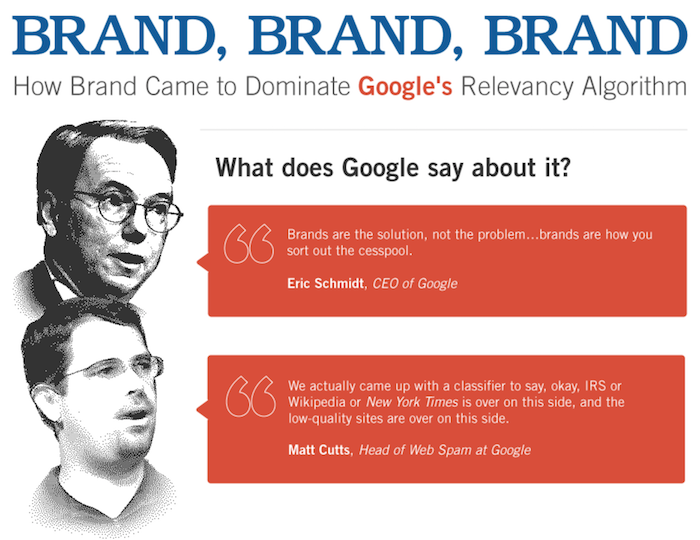
This is why brand queries (the number of users who search for your brand name on Google and click on your website) impact rankings, which I’ve broken down as one of the most important SEO lessons I learned.
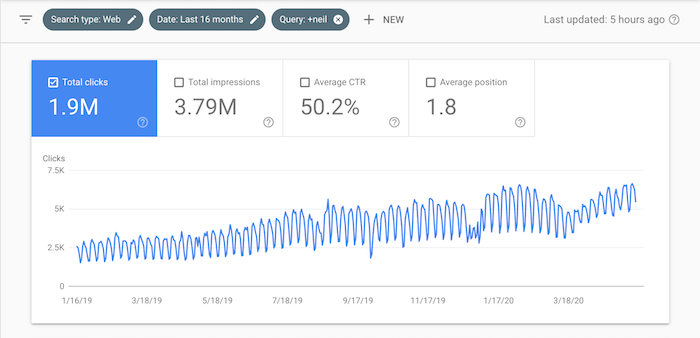
Just look at how the Neil Patel brand has grown over time… the graph below shows the number of people searching for my name over time:
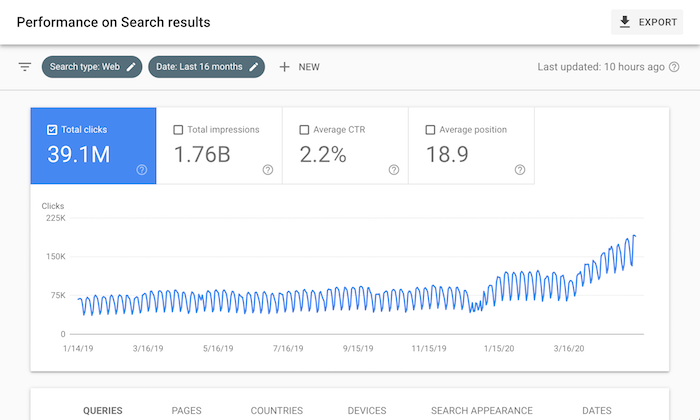
And here is my SEO traffic over time:
As your brand grows so will your SEO traffic.
But that is old news, that’s been part of Google’s algorithm for years now.
Here is the thing though, most sites don’t have large brands and Google knows that. So, if you don’t have one, you can still rank.
At my ad agency, when we look at our clients and their growth over time, only 4% have large well-known brands. The other 96% are still seeing traffic growth.
What Google is doing is adapting its algorithm to more closely align with the mission of showing the sites first that users love the most.
And yes, brand queries are one of the ways they can do this, but user experience is another metric.
Over the next few years, I bet you will see many algorithm updates focusing on user experience.
So how do you optimize your user experience?
It’s starts with each page
If you look at the original article Google posted about the future algorithm change, they emphasize “page experience” or “website experience.”
It doesn’t mean that your whole website shouldn’t have a good user experience, but instead, I bet they are going to focus on their algorithm from a page-level basis.
Because if you have a few pages on your websites that have a poor experience, but the rest are good, it wouldn’t make sense for Google to reduce the rankings of your whole site, especially if many of your pages provide a much better experience than your competition.
Here’s how you optimize your user experience:
Step #1: Optimize your speed and reduce 400 errors
The faster your website loads, the better experience you’ll have.
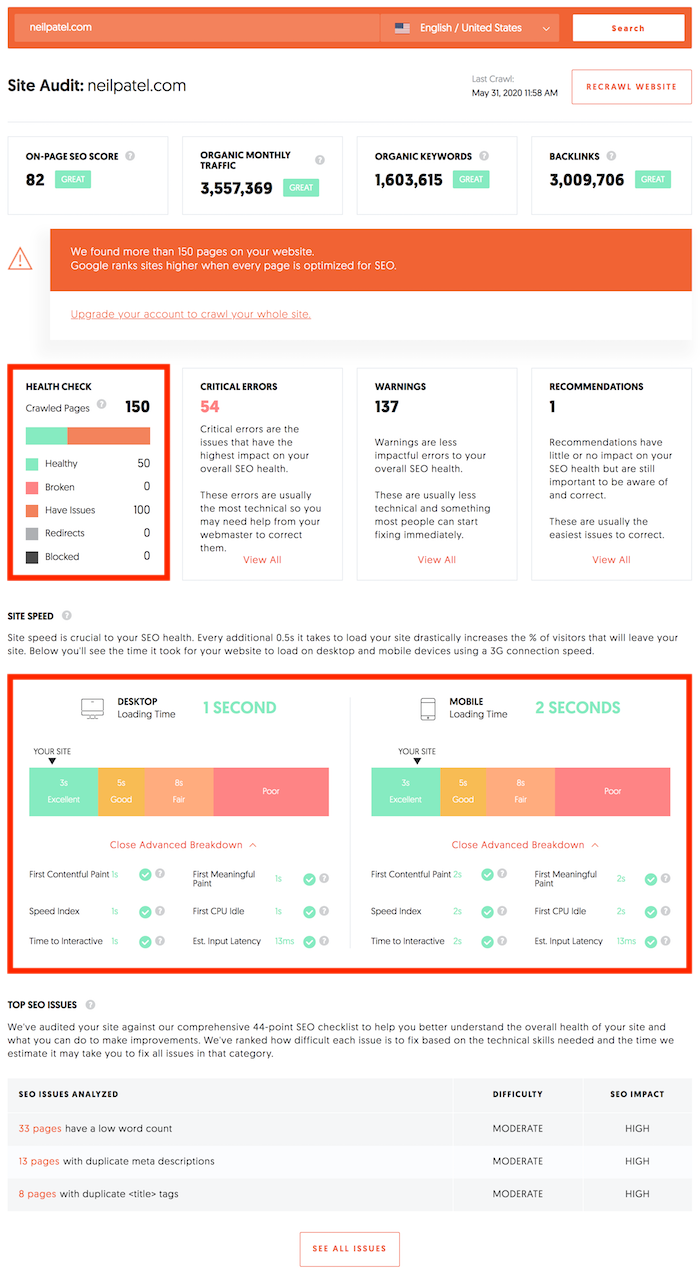
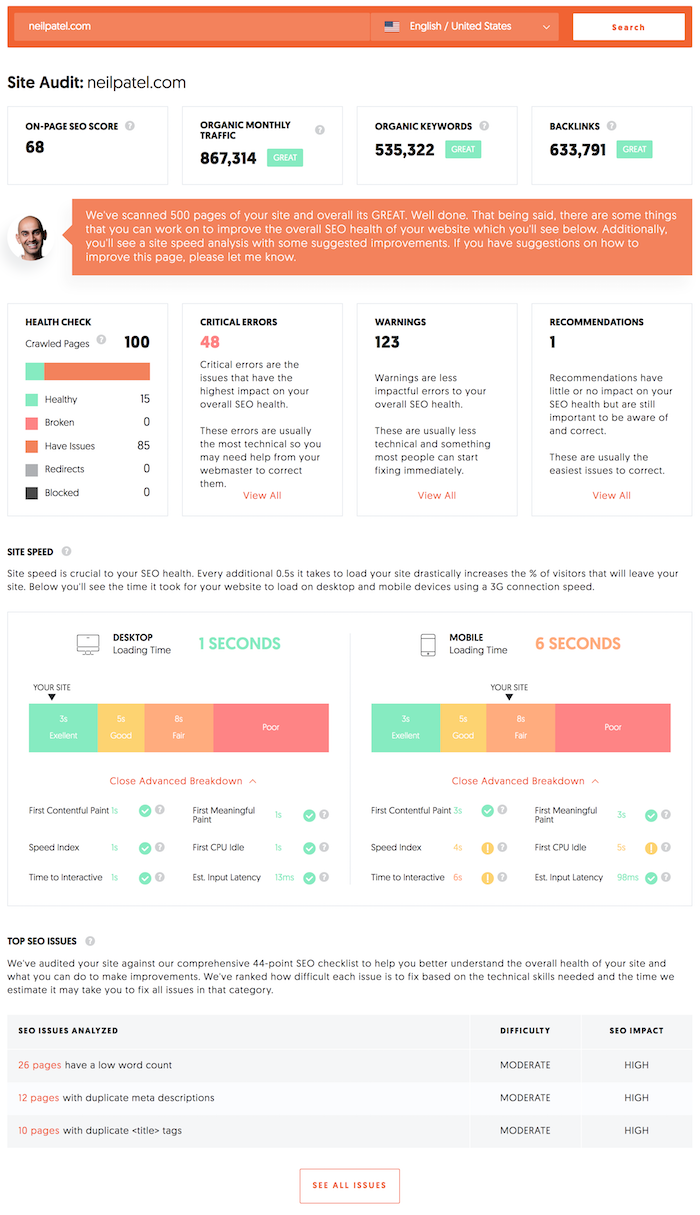
You’ll notice two important aspects of that report that impact user experience that I’ve highlighted in the screenshot above.
In the health checkbox, you’ll want to make sure there are no broken pages. Broken pages create bad experiences.
In the site speed box, you’ll see the load time of your site. The faster your site loads the better. Try to get your website load time for both desktop and mobile under 3 seconds.
Ideally you should be in the 1-second range if possible.
Step #2: Compare your experience to your competitions’
You may think you have an amazing user experience, but how does it stake up to your competition?
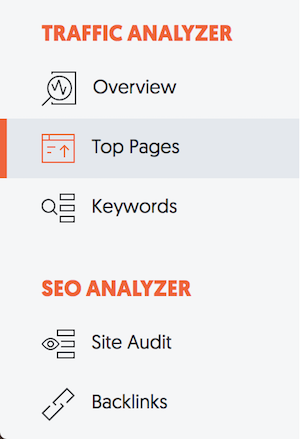
I want you to go into the navigation and click on “Top Pages.”
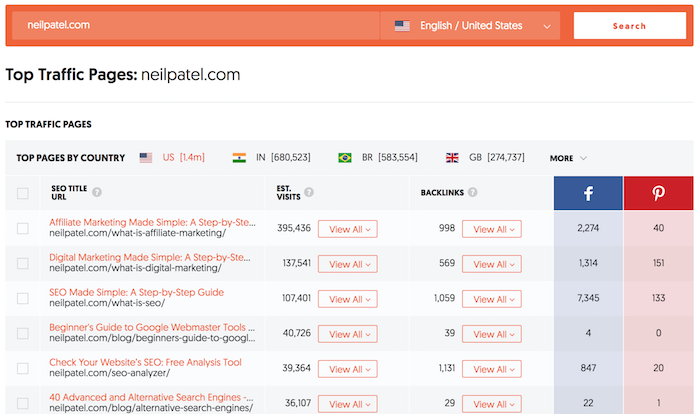
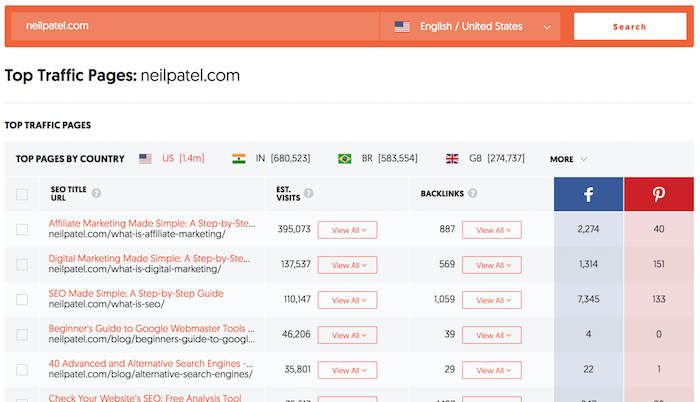
You should see a report like this:
The Top Pages report shows the most popular pages on your competition’s site from an SEO perspective. The pages at the top are the ones with the most SEO traffic, which means they are doing something right.
I want you to go through their top 50 pages. Seriously, their top 50 pages, and look at the user experience of each of those pages.
What is it that they are doing? How does their content quality compare to yours? What are the differences between their website compared to yours?
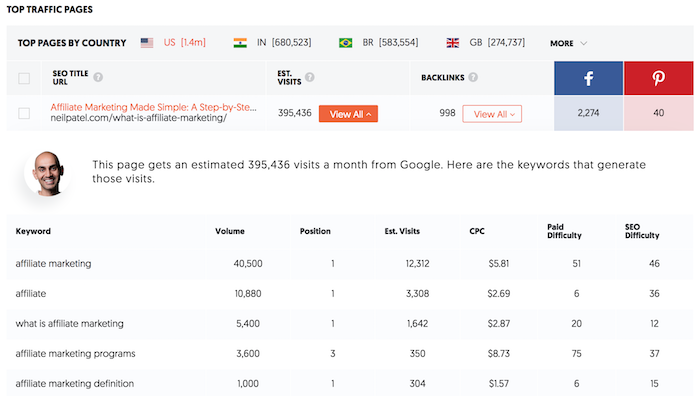
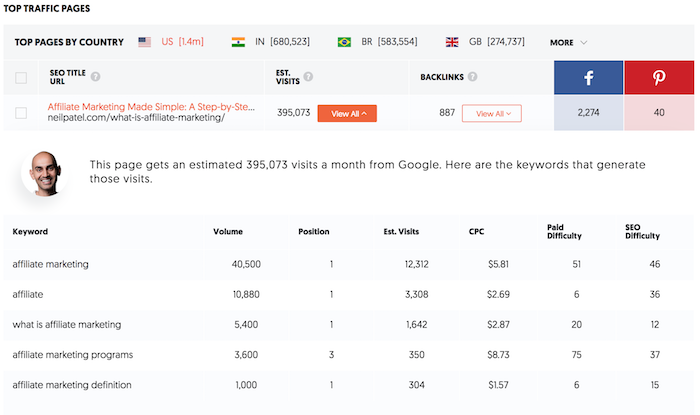
For each page that ranks, I also want you to click on “View All” under the “Est. Visits” heading. This will show you all of the keywords each page ranks for.
When evaluating your competition’s user experience, keep in mind how they are delighting people who search for any of those keywords. This will give you an idea of what you need to do as well.
But your goal shouldn’t be to match your competition, it should be to beat your competition.
Step #3: Analyze your design
Remember the graphic I showed above of what Google doesn’t want? Where the user tried to click on “No, go back” instead of “Yes, place my order” due to design issues.
In most cases you won’t have that issue, but you will have other usability issues.
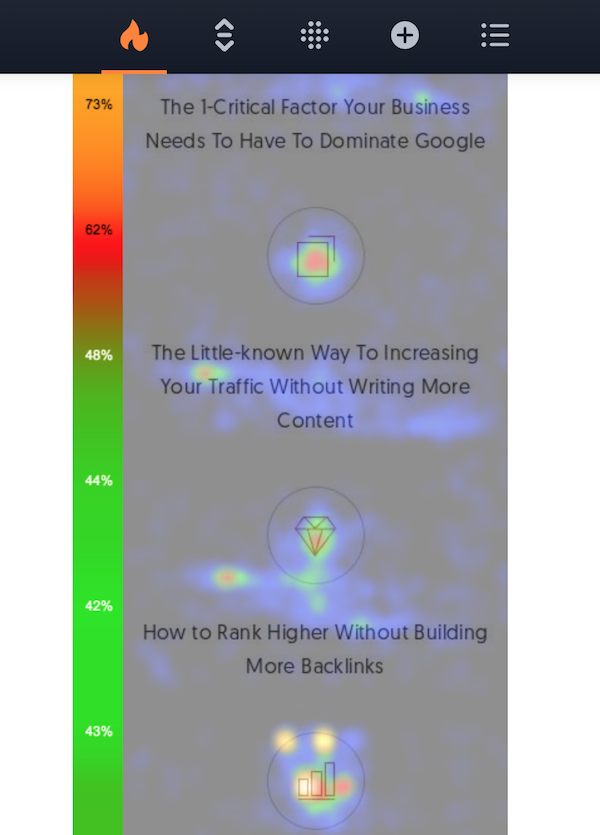
The way you find usability issues is through heatmaps. Just like this one:
What you can do to find usability issues is run a Crazy Egg test on your site.
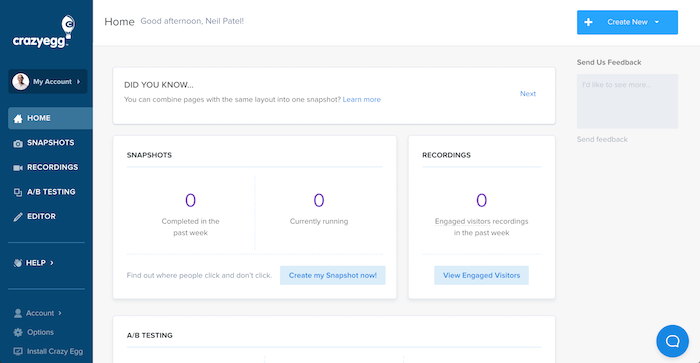
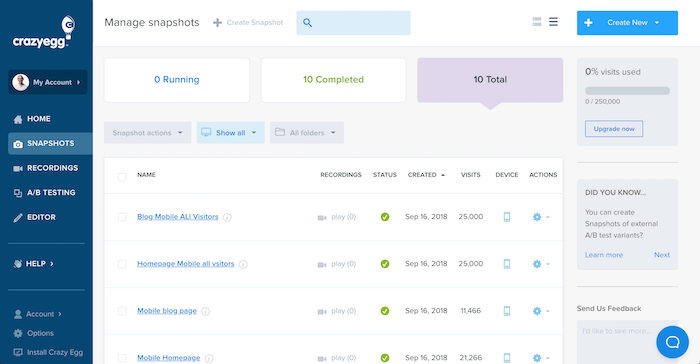
Once you log into Crazy Egg, you’ll see a dashboard that looks like this:
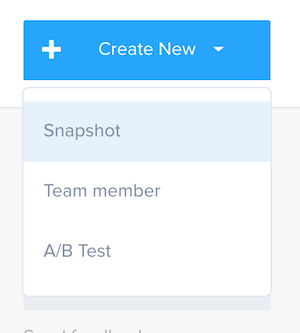
On the top right, I want you to click on “Create New” and select “Snapshot.”
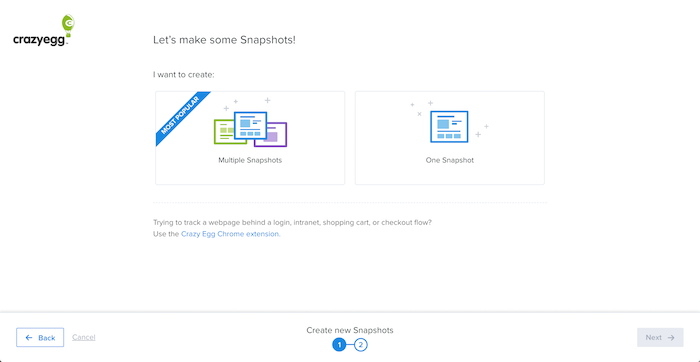
Then select “Multiple Snapshots.”
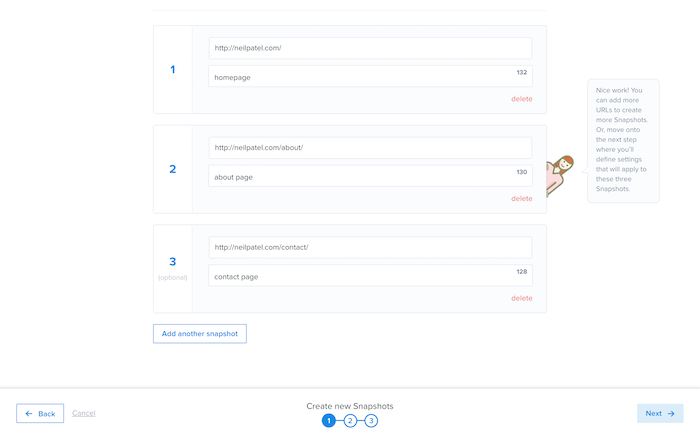
From there, you’ll want to add at least 3 popular URLs on your site. Over time you’ll want to do this with all of your popular pages.
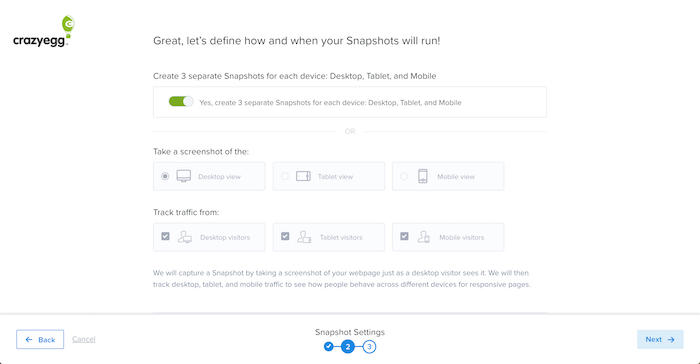
Then you’ll see settings like the image below, you don’t need to do anything here. Just click “Next.”
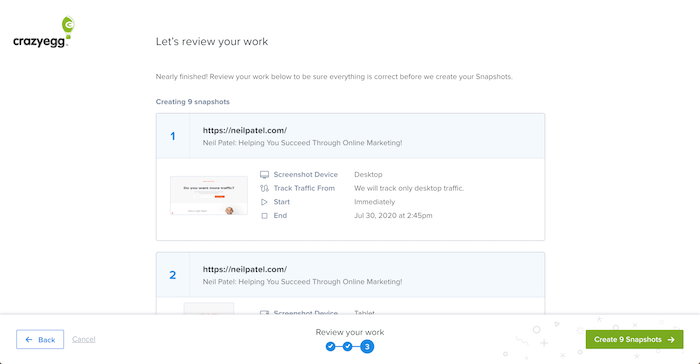
You’ll then be able to review everything. If it looks good, you can click the “Create Snapshots” button in the bottom right.
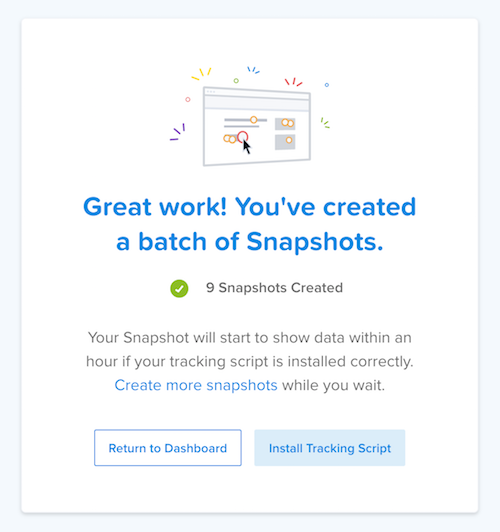
Last but not least, you’ll have to install your tracking script.
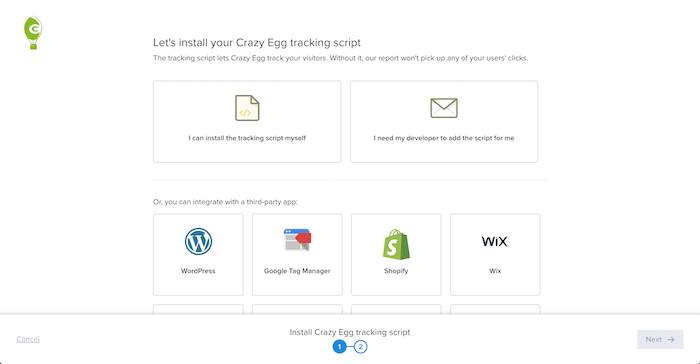
So, click on “Install Tracking Script.”
Select the option that works for you and then you are off and to the races. For example, for NeilPatel.com I use WordPress so I would select the WordPress option.
Once you are setup, it will take at least a day to see results, if not a bit longer. It depends on your traffic.
If you get thousands of visitors to your site each day you’ll see results within a few hours.
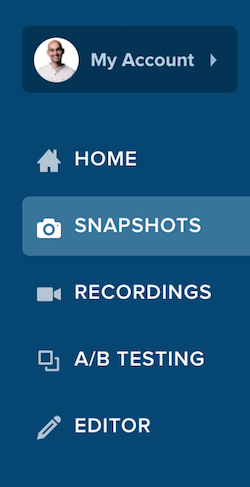
After you set up your test and it has been a few days, log back into Crazy Egg and click on Snapshots in the sidebar.
Once you are there you will see a list of snapshots you have created.
Click on any of your snapshots and you’ll see a heatmap of how people are engaging with your web page.
What’s cool about snapshots is they show you every single click, or even scroll that people take. Just look at this example from the NeilPatel.com site.
As you can see, people are clicking on those images above the text. But there is an issue… can you guess what it is?
If you click those images, nothing happens. But for all of those people to click on those images, it means that they believe they are clickable and that something should happen when they click on them.
An easy fix for me is to make them clickable and when a user clicks maybe I would take them to a page that goes into detail on each of those features. Or maybe I could expand upon each feature right there on that page.
Once you make the fixes to your page, you will want to re-run a new Crazy Egg snapshot on the same page to see if the changes helped improve the user experience.
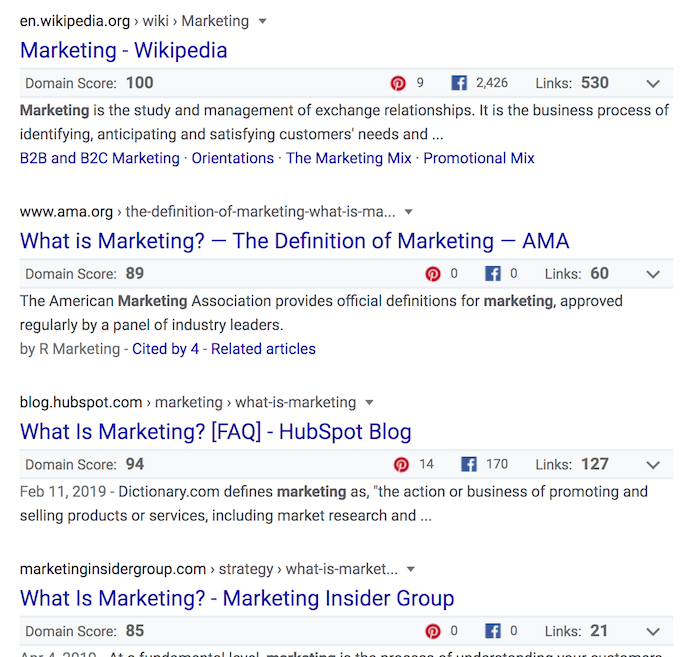
When you do a Google search, you’ll see data on each ranking URL.
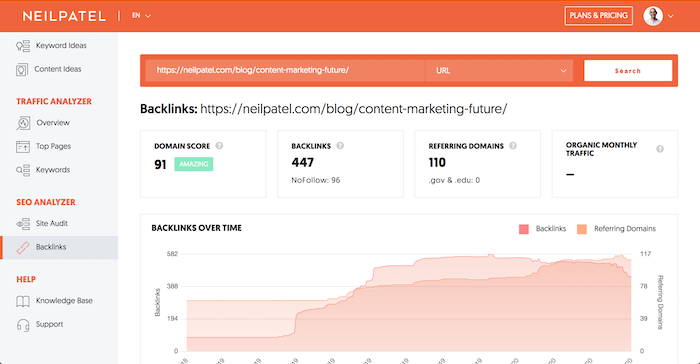
When you are naturally using Google throughout your day and searching for keywords related to your industry, I want you to look at 2 main metrics in Ubersuggest:
Domain score – the higher the number, the more authority a website has.
Links – the more links a website has, usually the higher it will rank.
So, when you are doing searches, look for sites that have a lower domain score and fewer backlinks than the competition, but yet still rank high.
Chances are, they rank high because of things like user experience. Maybe their text is more appealing than the competition, maybe their bounce rate is lower… it could be a wide variety of reasons, but these are the sites you want to look at and analyze.
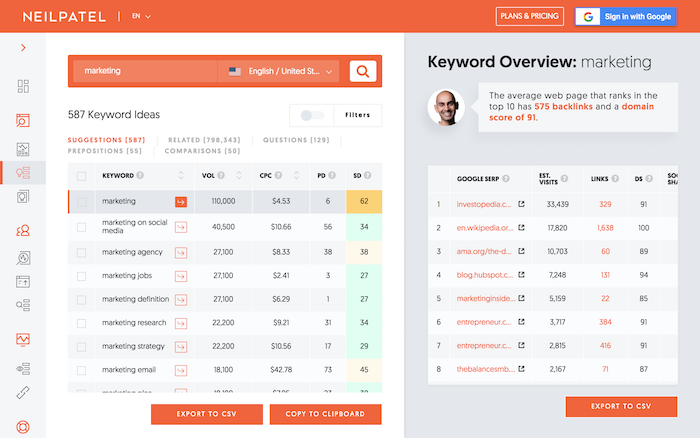
In the image above, you see that the result from the AMA ranks higher than Hubspot yet they have fewer links and a lower domain score. So, if you were trying to rank for that keyword, you would want to spend more time analyzing AMA because they are doing something right.
Conclusion
User experience is going to be more and more important over time.
If you love a site and everyone else loves that site, Google will eventually want to make sure that the site ranks high.
On the flip side, if everyone feels a website has a terrible user experience, then Google won’t rank that website as high in the long run.
Just like any algorithm update Google does, expect to see multiple revisions over time. As they learn, they adapt to make their algorithms more effective over time.
But what is unique about this update is you have advanced notice, which is nice. So, take the opportunity and fix any usability issues you may have.
What other ways can you make your website more usable?
From being in the SEO industry for over 21 years now, I know that it would be more convenient to do your SEO research while you are browsing the web or searching Google than constantly having to come back to Ubersuggest.
That’s why I created this Chrome extension.
So, what’s inside the Chrome extension?
Well, the easiest way to know what’s included (it’s free), is to just go and install it and test it out.
But here’s what’s included…
Keyword overview
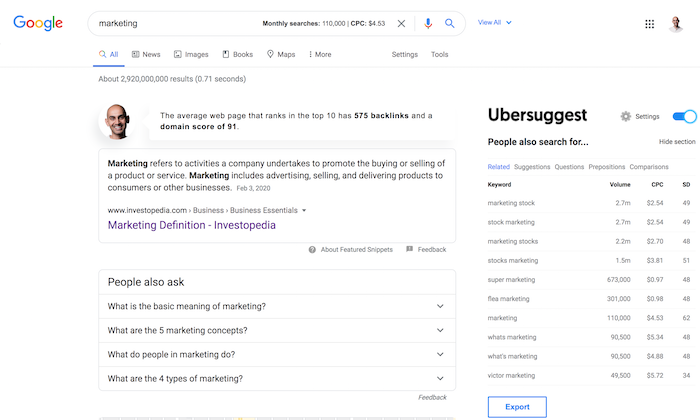
When you are searching Google, you’ll see an overview within the search bar.
You’ll see the monthly search volume and the cost per click for that keyword.
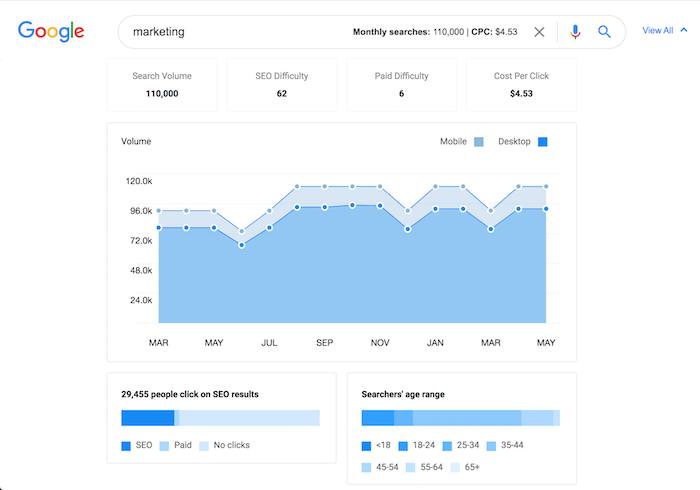
When you click the “view all” link, you’ll see a detailed overview for that keyword.
The graph breaks down the total monthly search volume. What’s cool about the chart is that it shows you both the monthly mobile searches and desktop searches.
And above the graph, you’ll get metrics on how hard that keyword is to rank for (SEO Difficulty) and how competitive that keyword is from a paid advertising (Paid Difficulty) standpoint.
Under the graph, you’ll also see 2 bar graphs. The first one breaks down whether or not people are clicking on the SEO results, paid results, or not clicking anywhere at all.
The second one shows data on the age range of all of the searchers.
Link overview
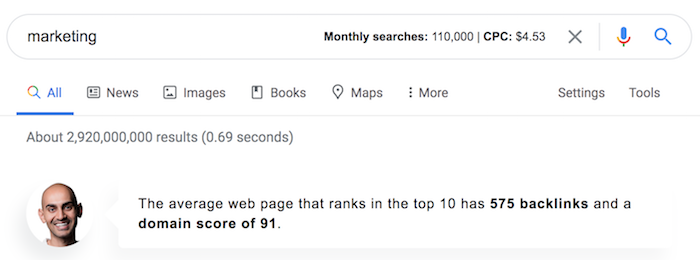
Above the organic results, you’ll see a speech bubble that breaks the average authority of the sites that are ranking (domain score) and the average number of referring domains the top 10 results have (backlinks).
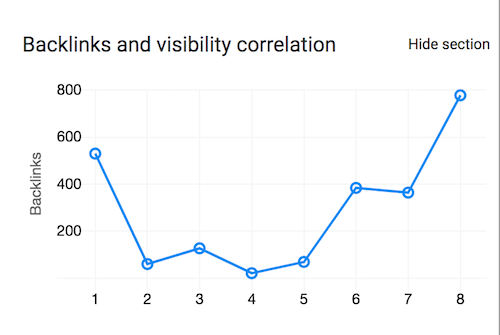
If you want a more detailed overview, you’ll see a graph in the sidebar that breaks down how many referring links each of the top 10 listings have.
Keep in mind the link metrics are based on referring domains. So, if a website has 100 links from the same domain name, it will only count as 1. Because what really matters when it comes to SEO is how many unique, relevant sites you can get to link to you as opposed to having the same site linking to you over and over again.
Even more keyword data
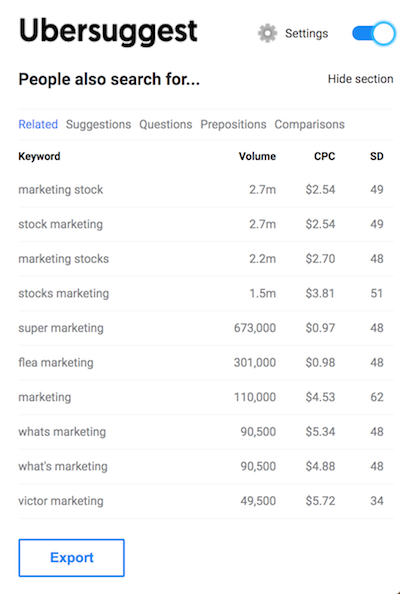
In the sidebar, you’ll also find even more keyword data.
You’ll see a list of other popular keywords that are similar. You’ll also get metrics on each keyword… from how often it is searched (volume), to what it would cost to bid on that keyword (CPC), to how difficult the keyword is from an SEO standpoint (SD).
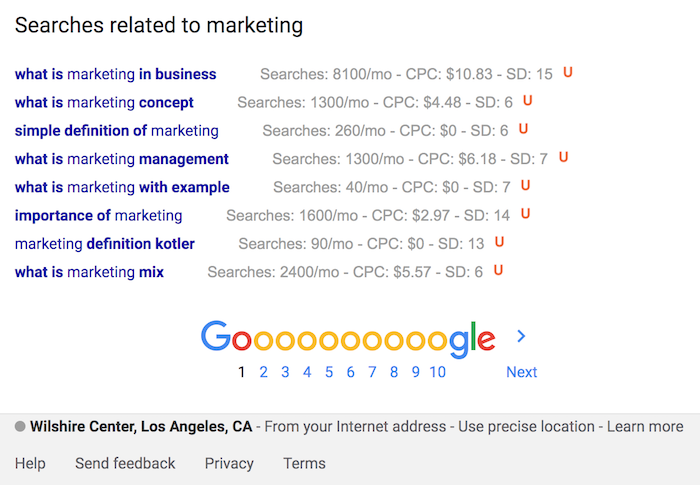
And if you scroll to the very bottom of the screen, you’ll see a list of related keywords that Google provides.
Again, you’ll be provided with data like search volume, cost per click, and SEO difficulty data.
URL metrics
Whenever you perform a search on Google, you, of course, see a list of websites that rank for that keyword.
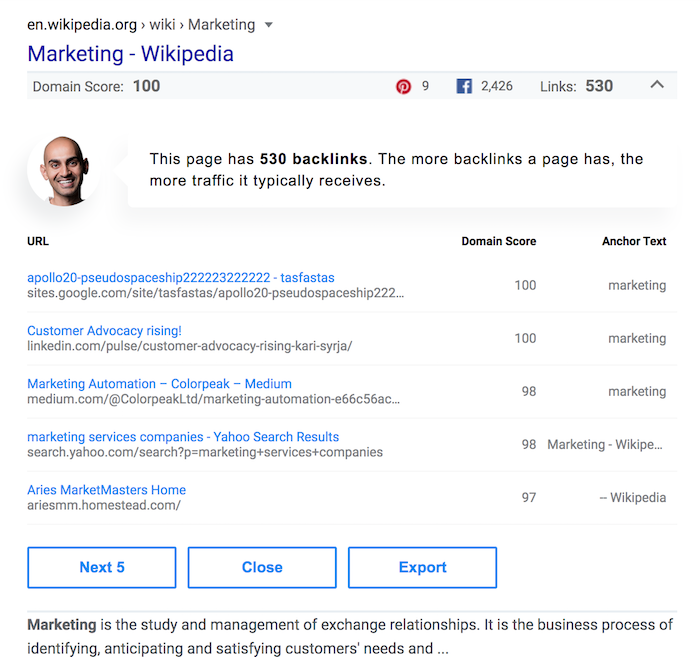
As you can see, under URL you see the authority of the website (domain score), how many Pinterest and Facebook shares the URL has, and how many unique domains are linking to that result.
What’s cool is you can click on the “down arrow” next to the link count and see the exact list of sites linking as well as their domain score and anchor text they used for the link.
Pick your country and language
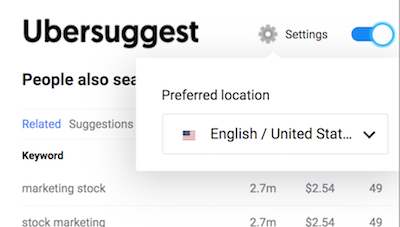
The last feature in the extension is that you can change your location and language.
All you have to do is click the “Settings” link in the sidebar.
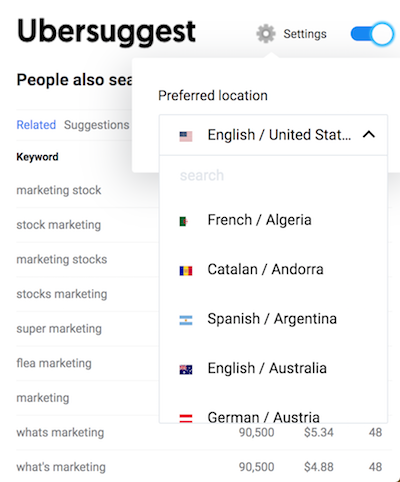
You’ll see a long list of languages and countries that you can choose from.
No matter what version of Google you are using, such as Google.com.br or even Google.co.in, you’ll see SEO data whenever you perform a search.
Conclusion
I have some more big changes coming to the extension in the near future but I would love to hear what you think about it so far.
And if you have any feature requests, just leave a comment below. That way we can prioritize what we add to the extension next.
I know that sounds contradictory because if you are an SEO, why wouldn’t you obsess about traffic, right?
Well, it’s because I’ve learned some hard lessons over the year… mainly because I’ve made a lot of mistakes.
So today, I wanted to share them with you so that you can learn from my mistakes… so here goes:
Lesson #1: Don’t obsess over rankings, obsess over conversions
I used to check my rankings every single day. Literally.
On top of that, I would log into Google Analytics 4 to 5 times a day and continually check my traffic.
That’s all I cared about back in the day… boosting my organic traffic.
But here is the thing: As my rankings and traffic went up over the years, my revenue didn’t go up proportionally.
For example, during one quarter in 2017, my SEO traffic went up 39.52%, but my revenue from SEO went up only 4.29%.
I quickly learned that traffic isn’t everything. If you can’t convert the traffic into revenue it doesn’t matter.
That taught me that you need to focus on the right keywords that drive conversions and continually optimize your site for conversions.
An easy first step for you to take is to install Crazy Egg and run a heatmap to see where people click so you adjust your design and copy to get more sales.
Lesson #2: The easiest way to grow your SEO traffic is international expansion
You already know that I get a lot of SEO traffic, but do you know what country drives most of my traffic?
If you guessed United States, you are wrong.
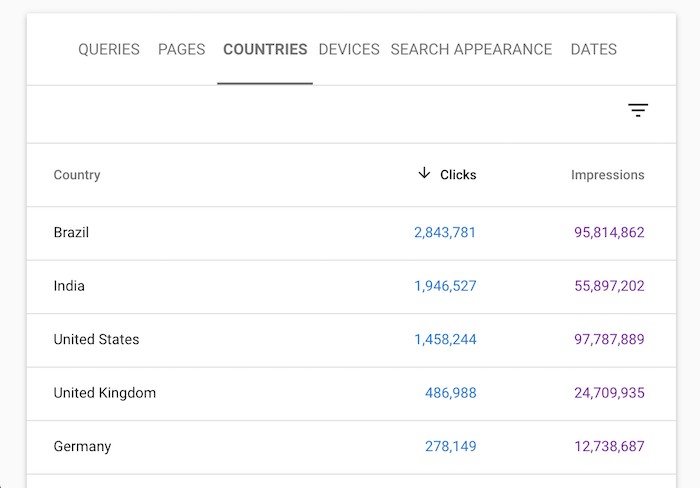
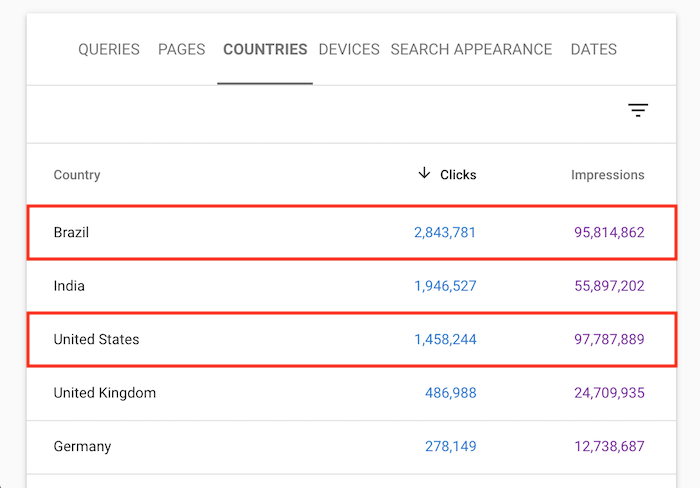
Brazil is my most popular region, followed by India.
International SEO is the easiest way to expand and grow your traffic. Here are a few posts that you should read before you expand your SEO globally:
Lesson #3: Keywords are very, very, very, very important
When I used to write my content, I didn’t obsess about the keywords when I should have.
My team actually proved me wrong on this.
I used to focus on writing content for humans and didn’t worry about search engines. My team, on the other hand, obsesses about keywords.
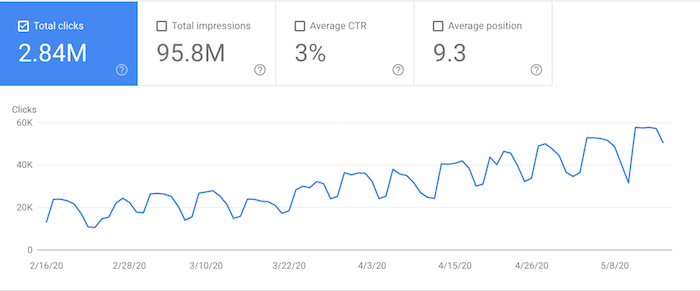
Just look at the growth of our traffic in Brazil because of our obsession with the right keywords.
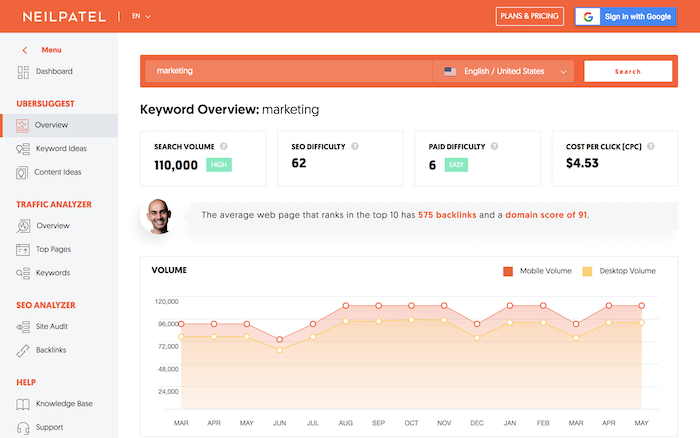
One simple thing I do before writing that has really helped is I head over to Ubersuggest and type in a few of the keywords that I want to go after.
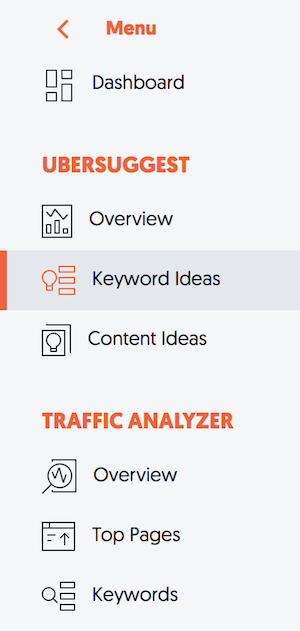
Once it loads, you’ll see a report like the one above. I want you to then click on “Keyword Ideas” in the left-hand navigation.
You’ll see a report that contains a list of keywords that you could potentially be targeting.
Make sure you click on the “Related” tab, as well as “Questions” and “Comparisons” … scroll through the list. You’ll see hundreds of keywords. Pick all of the ones that are relevant and ideally have a high cost per click (CPC). These are the keywords that’ll not only drive traffic but revenue as well.
Whenever I write a blog post, I go through this step. Every single time.
Lesson #4: AMP pages can drive more SEO traffic
AMP pages load faster on mobile devices than non-AMP pages.
If you aren’t familiar with the AMP framework, read this.
What most people won’t tell you about AMP pages is that:
In regions like the United States, Canada, and the United Kingdom, countries with decent Internet infrastructure, you won’t see much of an increase in traffic.
In regions with poor Internet infrastructure, like Brazil, you’ll see a 10 to 15% lift in mobile SEO traffic by having AMP pages.
AMP pages don’t convert visitors into customers as well as normal responsive web design. So, you’ll have to work on testing your AMP pages so you can boost your conversion rates.
Lesson #5: SEO will never convert as well as paid ads
When I started off with SEO, I would run projections on how much the traffic would make me.
But the numbers were always off, even if I was able to get the rankings.
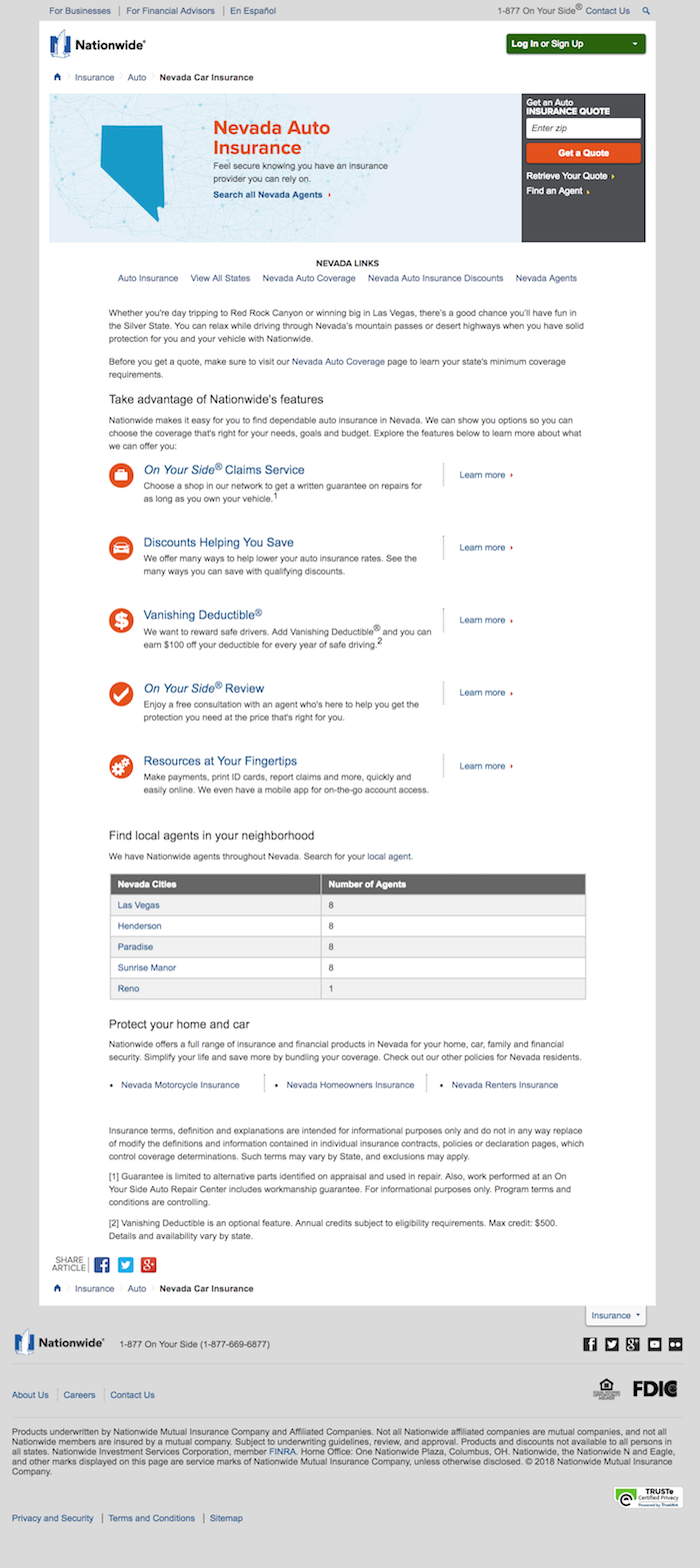
Here’s the main reason: If you are bidding on terms like auto insurance through ads, you can drive people to a landing page that looks like this:
But if you want to rank organically, you’ll have to do it through content. So, your page that ranks well will look more like this and convert less…
It doesn’t mean SEO is bad. In reality, it’s much cheaper in the long run than paid ads and will produce a better ROI. But don’t just assume that if you get 100 visitors from paid ads and 3 purchases that you’ll have the same conversion rate with your SEO traffic.
Chances are it will be significantly lower by maybe 2 or 3x, but because SEO is cheaper, it will be much more profitable.
Lesson #6: Remarketing is one of the best ways to generate an ROI from SEO
If you get a ton of traffic from SEO, there is a simple strategy you can implement to boost your conversions.
Remarket everyone on Facebook, Google, and YouTube.
That way people come to your site, read your content, and build trust with you and your brand.
Then you remarket them throughout the web with ads that prompt your products or services and send them to a landing page that will drive sales.
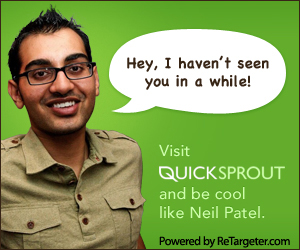
I’ve been doing this for years, just look at my old remarketing ad…
For the regions I use remarketing in, it is responsible for 46% of my leads.
Lesson #7: Don’t forget to update your old content
I publish one new blog post a week. I’m working on increasing this as I get more time, but for now, it is one a week.
Can you guess how many blog posts I update on a daily basis? Technically it is 0 (me at least), but my team focuses on updating at least 3 old blog posts per day. That’s roughly 90 a month.
Once you have a few hundred pages, make sure you focus on updating your old content or else your traffic will quickly drop.
You can use this content decay tool to see which posts you should update first.
This will help you continually grow your SEO traffic instead of hitting plateaus or seeing your traffic take massive drops.
Lesson #8: Don’t forget to optimize your title tags
One of the easiest ways to grow your rankings is to optimize your title tags.
If you can write persuasive copy and get more clicks, you’ll quickly move up on Google.
In Brazil, we spend more time doing this than we do in the United States.
We get a similar amount of impressions in Brazil, but we have more people focusing on improving our title tags and testing. Hence, we get 95% more SEO traffic in Brazil.
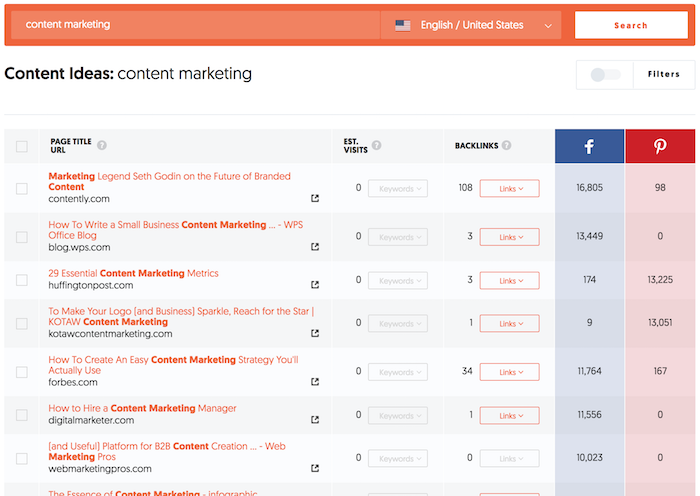
Another simple hack is to use the “Content Ideas” report in Ubersuggest.
On the right side of that report, you can see social share counts from Facebook and Pinterest. And on the left side, you see titles of articles.
Typically, if people like a title they share it more. So, look for titles that have a lot of shares as it will give you ideas on what you can use on your website to get more clicks and boost your rankings.
Lesson #9: Don’t put dates in your URL
I used to put dates in my URLs like:
Neilpatel.com/2017/12/title-of-post/
This causes search engines to assume that your content is related to a specific date. And after that date gets old, search engines assume your content is irrelevant and outdated.
The moment I removed the date from my URLs, I grew my SEO traffic by 58% in 30 days.
The majority of your pages that will rank are blog-related content. And blog posts tend to drive fewer direct conversions because people are on your site to read the content.
In order to maximize your conversions from SEO, you should consider using exit popups so you can convert more of those visitors into customers as they leave.
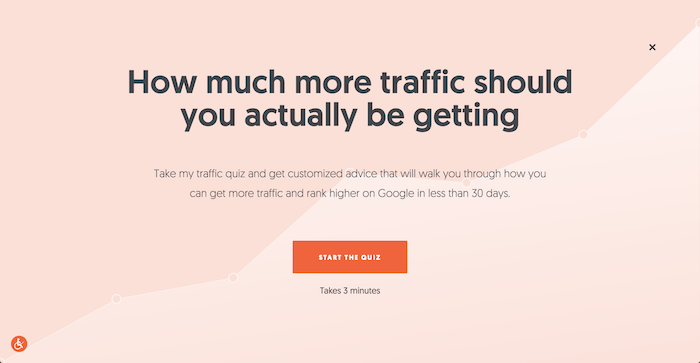
When you leave this site in most cases, you’ll see a popup that looks like:
And it drives you to this quiz, which allows me to convert SEO visitors into customers.
You can easily copy me by using Hello Bar. It works for all industries including B2B and ecommerce and even lead generation sites.
Lesson #11: Brand queries affect rankings
Everyone talks about how you need links to boost rankings.
One of the big reasons for my growth in SEO traffic is the growth in my brand. I’ve seen a direct correlation in which the more people who find me from my name, the more SEO traffic I get.
Just look at my brand growth over time:
I’ve received over 1.9 million visitors over the last 16 months from people typing in variations of my name in Google.
Lesson #12: Don’t waste your money on paid links
I’ve been doing SEO since I was 16 years old. That’s a long time…
When I started off as a kid, I dabbled in paid links and I used to dominate Google for terms like online casino, online poker, web hosting, auto insurance, and even credit cards.
And I was making a killing off of affiliate income from these sites.
But it was all short lived.
Why?
Because I bought links. And eventually Google penalized all of those sites.
If I never purchased links, those sites would have taken longer to rank, but they would have been around today, and I would have generated more income overall.
Don’t buy links, it’s bad and shortsighted.
Lesson #13: Guest post to build a brand, not to build links
I already covered the importance of branding above.
A great way to build your brand and indirectly boost your SEO traffic is through guest posting.
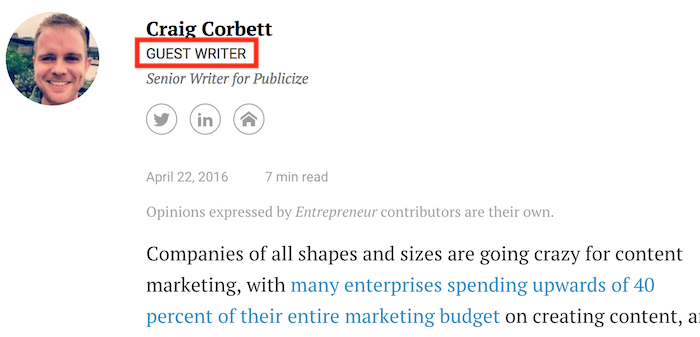
It’s pretty easy to spot a guest post for both a human and algorithm…
But if you are using it to build a brand, great. Focus on the content quality and not links.
Lesson #14: Don’t forget to interlink
Do you know what some of my highest ranked pages are?
The ones that are interlinked.
It takes anywhere from 6 months to a year for many of the interlinks to kick in, but it is still effective none-the-less.
Every time I wrote content, I used to make sure I link out to my older pieces of content when it made sense. But I made a big mistake… I wasn’t going into my older pieces of content and then adding links to my newer pieces of content.
That one change was game-changing for me. It took time to see the results but it worked exceptionally well.
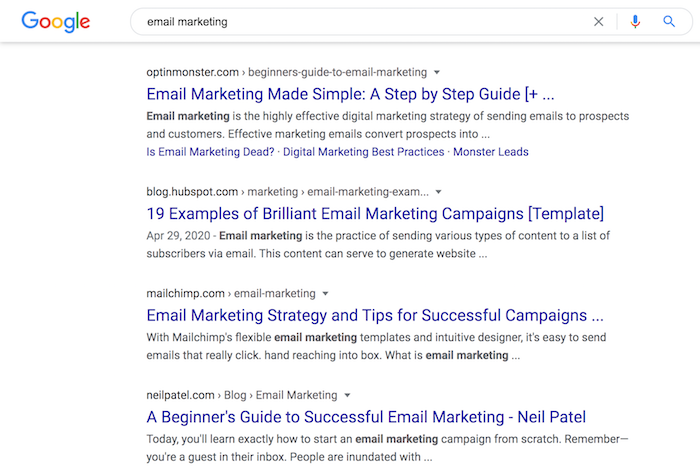
It’s how I rank high for terms like “email marketing”.
Lesson #15: Google isn’t the only game in town
Although Google is the most popular search engine, it isn’t the only one you need to focus on.
Did you know that YouTube is the second most popular search engine?
Focus on writing high-quality content. It’s why I blog less and try to make my content amazing.
Lesson #18: Tools are better than content marketing
I used to focus all of my energy on content marketing because it drove a lot of links and SEO traffic.
But over time, I realized that creating free tools builds more natural links than anything else I have ever tested.
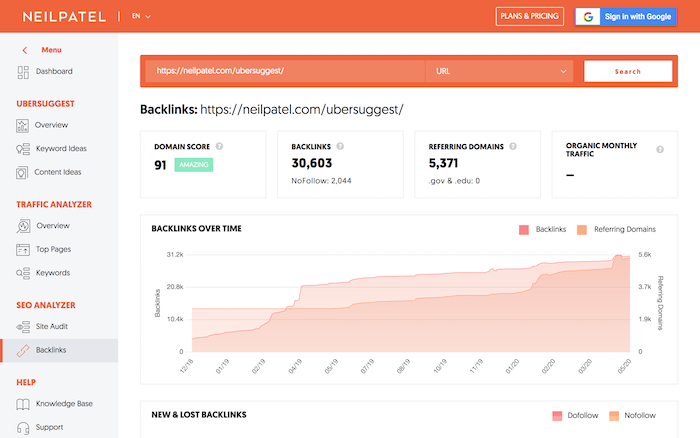
Just look at Ubersuggest. I spent years creating it and look at how many links it has generated…
30,603 backlinks! That’s a lot of links.
If you don’t have the resources to build a custom tool like me, you can always start with buying a white label tool from Code Canyon for $10 or $20. They literally have tools for almost all industries.
Lesson #19: Don’t rely only on SEO
When I first got started in SEO, all I could think about was SEO.
To me, it was the best marketing channel out there because it allowed me to compete with large companies.
Even to this day, I still love SEO more than any other channel.
But it doesn’t stop me from leveraging other marketing channels.
See, years ago you could build a business off of one marketing channel.
Yelp was built through SEO. Dropbox through social media referrals. Facebook through email invites…
Those days don’t exist anymore. You can’t just build your traffic from one channel.
Although you should do SEO, you should also try paid ads, social media marketing, email marketing, push notifications, and anything else that comes out.
Diversify your traffic sources and don’t just rely solely on SEO.
Lesson #20: People love linking to data
Spending money and time to gather your own unique data is an easy way to build links.
Within a two-year period, from 2010 to 2012, 47 infographics generated 2,512,596 visitors and 41,142 backlinks from 3,741 unique domains. They also generated 41,359 tweets and 20,859 likes.
If you don’t have money to hire a designer, you can use Infogram or Canva to create one on your own.
Lesson #22: Google doesn’t penalize for duplicate content
You don’t want to post tons of duplicate content on your site as it’s not the best user experience, but keep in mind that Google doesn’t penalize you for duplication.
They may not just rank the duplicate content as well.
So, if you spend all of this time producing amazing, unique content, why not publish it FIRST on your own website.
Then after a few hours or days if you want to be safe, take that exact content and publish it on Facebook, LinkedIn, and anywhere else that will accept your content.
Literally, take all of the words and paste them onto those social channels.
It will get you extra awareness and branding. Plus, the content should already be indexed on your site, so Google knows it came from your first… and I doubt you care if the duplicated version on LinkedIn ranks. That’s still great branding.
In other words, don’t be afraid to repurpose your content even if it causes duplication.
Just look at this post, for example. I’m also repurposing it into a 4-part podcast series.
Lesson #23: Don’t recreate the wheel
I used to spend hours a week doing keyword research trying to figure out what new terms to rank for.
Eventually, I figured out an easier and better way to find new content topics and keywords to go after.
Go to Ubersuggest, type in your competitor’s domain name and hit search.
In the left-hand navigation click on Top Pages.
You’ll see a report that shows you all of the popular pages on your competition’s website. This will give you ideas for the type of pages you should create on your website.
Then I want you to click “View All” under Est. Visits (estimated visits). This will show you all of the keywords that drive traffic to that page.
You now have a list of topics and keywords for each topic to go after.
Lesson #24: Don’t pick a generic domain name
Remember how in Lesson 11 I talked about brand queries and how they helped rankings?
After I learned that, I decided to go buy exact match domain names where the domain name was the keyword.
That way I would get lots of brand queries without trying.
Well, there’s an issue… even if you rank high, what you’ll find is you will have a low click-through rate in most cases.
If you have a low click-through rate, it tells Google your brand isn’t strong and people don’t prefer it, which can hurt your ranking.
So instead of focusing on exact match domains, unless you have millions to spend on branding like Hotels.com, focus on building a memorable brand.
Pick something that is unique, easy to spell, and easy to remember.
Lesson #25: Learn from blackhat SEOs, but don’t go over to the dark side
Blackhat SEOs come up with some interesting data and experiments.
Many of them don’t work for long, but they are interesting none-the-less.
Although I don’t recommend practicing blackhat SEO, I do recommend following them.
The easiest way you can learn from them is by reading Blackhat World.
People there share some interesting insights, especially every time there is a major Google algorithm update.
Again, I don’t recommend practicing blackhat SEO, but following them may help you uncover “white hat” techniques that can increase your rankings. Not everything they do is bad… many of them use legitimate tactics as well.
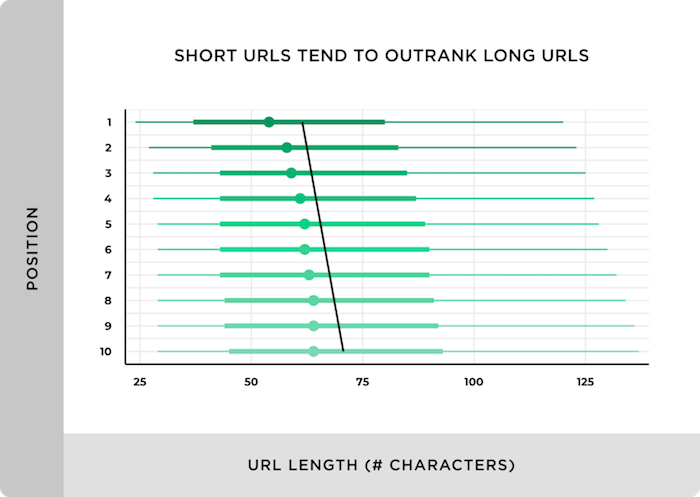
Lesson #26: Short URLs rank better than long ones
My URLs used to be the title of my blog post.
For example, with this post I would have used this URL in the past…
URLs at position #1 are on average 9.2 characters shorter than URLs that rank in position #10. So, keep them short.
Lesson #27: The power’s in the list
If you want your content to rank high on Google, you need more people to see it.
Whether it is from social shares, or from push notifications or email blasts… the more people that see your content, the more engagement it will get, and the more people that will link to it.
I used to do a ton of manual outreach every time I published a new blog post and I would email people asking them to link to me.
And it works, it’s just time consuming and a pain.
These days, I have a better strategy… send out an email blast every time I publish a new post.
I can now get anywhere from 20,000 to 50,000 clicks per email I send out.
Now of course you won’t get that from day one as it took me years to build up my email list.
But you can start today by collecting emails. You can easily do that through Hello Bar.
And as your list grows, so will the clicks to your blog and the number of links you get, which in turn will increase your rankings.
Lesson #28: Don’t let your foot off the peddle
This was one of the hardest lessons I learned.
It’s exhausting to continually blog and do your own SEO. Sometimes you just want a break.
With my old blog, Quick Sprout, I used to publish 12 blog posts a month and I did that consistently for 3 years.
One day I decided that I wanted to stop for a month. So, I took a 30-day break.
Guess what happened to my traffic?
It tanked by 32%.
So, then I started blogging again. And guessed what happened to my traffic after I started blogging?
It didn’t come right back.
It took me 3 months to get back to where I was.
When things are working for you, don’t slow down. Keep pushing harder, even if you are exhausted. Because the moment you stop, you’ll drop, and it is a lot of work to get back to where you were.
Lesson #29: The best SEO advice comes from conferences
The best SEO advice I have ever learned over the years has come from conferences.
And no, I don’t mean by sitting in on the sessions, although you can learn from those too.
The best SEO secrets and advice I learned came from networking. When you go to these conferences, hundreds if not thousands of other SEOs are there. And when you go to the bar after hours and mingle with people, you’ll quickly pick stuff up.
You’ll be shocked at what people tell you. It’s how I learned a lot of the good tactics that I still use today.
Lesson #30: Never stop learning
This one may sound obvious but when things are going well, people get complacent.
Just think about that for a bit… that’s roughly 9 algorithm updates per day.
Because they are changing so quickly, you won’t survive if you don’t stay up to date.
Yes, the ideal strategy is to do what’s best for your users or visitors as in the long run, Google wants to promote those sites, but it doesn’t mean that you can ignore the changes happening in the industry.
Read all of the SEO blogs out there, attend conferences as I mentioned above… experiment on test sites… push yourself to be better.
That drive of always improving and always wanting to learn more has helped me tremendously. It’s one of the reasons for my growth in rankings over the years.
Conclusion
There are a lot of lessons that you will learn as your rankings grow and as you spend more time on SEO.
But hopefully, you don’t have to waste time and go through the same mistakes I made. You don’t want to learn these lessons the hard way.
That’s why I decided to share them. I want to save you the time and help you achieve your traffic goals faster.
Transformar clientes em leais a marcas não é tarefa fácil. Por um lado, você precisa de uma estratégia previsível e repetível para incentivar os clientes a comprar novamente de você. E é aí que entram os programas de fidelidade do cliente.
Com a iniciativa certa, você pode transformar compradores iniciantes em clientes recorrentes e manter sua marca em mente. Hoje, mostrarei o melhor programa de fidelidade que você pode modelar para gerar mais vendas, melhorar a retenção de clientes e criar relacionamentos mais fortes com os clientes.
Os programas de fidelidade incentivam os compradores a voltar às lojas onde costumam fazer compras. Alguns dos incentivos podem incluir acesso avançado a novos produtos, descontos adicionais ou, às vezes, mercadorias gratuitas. Os clientes geralmente registram suas informações pessoais na empresa e recebem um identificador exclusivo, como um ID numérico ou cartão de membro, e usam esse identificador ao fazer uma compra.
Os programas de fidelidade são oferecidos por varejistas e outras empresas como uma maneira de atrair e reter clientes. Esses programas de fidelidade oferecem recompensas, descontos ou outros incentivos especiais e são projetados como uma recompensa pela fidelidade à marca.
Eles beneficiam as empresas não apenas desenvolvendo a lealdade dos clientes, mas também fornecendo informações cruciais sobre como os clientes estão gastando e quais produtos ou tipos de ofertas são mais atraentes.
Neste artigo, apresentaremos os benefícios em obter um programa de fidelidade da Zupy através de Fabio Martinelli. Continue lendo para saber mais!
O QUE É UM SISTEMA DE FIDELIDADE?
Um programa de fidelidade de clientes ou programa de recompensas é uma estratégia de marketing que recompensa clientes fiéis que frequentemente se envolvem com uma marca.
Ao premiar o envolvimento recorrente, você pode aumentar a lealdade do cliente e garantir um crescimento contínuo para os seus negócios. A ideia por trás de um programa de fidelidade eficaz é que quanto mais os clientes porem fiéis, mais recompensas receberão. Construir um programa de fidelidade do cliente é um grande empreendimento para qualquer empresa e pode ser uma oportunidade de mudar o jogo, se criado com cuidado e precisão.
“Mas por onde devo começar?” “Quanto tempo levará para implementar?” “Quais recursos devemos incluir?” “Existem erros comuns a serem evitados?” “E se meus clientes não gostarem?” – estas são perguntas que você provavelmente se perguntou enquanto fazia sua pesquisa.
Ainda assim, se você está lendo isso, sem dúvida está determinado a chegar ao fundo das coisas. E você certamente veio ao lugar certo!
COMO FUNCIONA O CARTÃO DE FIDELIDADE DA ZUPPY
Os programas de fidelidade oferecem duas funções principais: recompensam os clientes pela lealdade à marca e fornecem à empresa emissora uma riqueza de informações do consumidor. Embora as empresas possam avaliar compras anônimas, o uso de um programa de fidelidade oferece detalhes adicionais sobre o tipo de produtos que podem ser comprados juntos e se determinados cupons são mais eficazes que outros.
Quando os programas de recompensas são integrados à rotina diária do cliente, eles podem cultivar a verdadeira lealdade à marca. De várias maneiras, a Zupy está fazendo isso criando experiências móveis únicas que conectam um cliente ao produto ou serviço da marca. Quando um cliente se sente confortável com o aplicativo, ele começará a confiar que a Zupy fornecerá uma experiência consistente a cada momento.
Os programas de fidelidade podem fornecer dados importantes de gastos dos clientes de uma marca.
O cartão de fidelidade da Zupy continua sendo o estudo de caso padrão de como uma marca pode reter clientes por meio de ofertas interativas. O aplicativo funciona como qualquer outro programa de recompensas, pois os clientes ganham pontos para usar em futuras compras. Ele se diferencia de outros sistemas de fidelidade, oferecendo aos clientes uma maneira conveniente de fazer pedidos antecipados, pagar na loja e muitos outros benefícios do Clube de Vantagens.
O QUE VOCÊ GANHA COM O CARTÃO DA ZUPY?
Ao adquirir o cartão de fidelidade da Zupy, é entregue um kit de boas-vindas ao cliente que fecha contrato com você. Esse kit será usado como material de divulgação inicial para o Programa de Fidelidade do cliente, você vai verificar as necessidades por exemplo, Banner, Cartazes, Folhetos, e muitos outros materiais de divulgação úteis.
No entanto, não é necessário nenhum conhecimento técnico. O sistema da Zupy é muito simples de ser utilizado. E mesmo através da plataforma você conseguirá criar os cartões de fidelidade e configurar as Campanhas de WiFi Marketing de seus clientes, você só precisa saber utilizar a internet, um conhecimento básico para editar imagens ajuda, mas não é trivial.
Os programas de fidelidade têm vários objetivos: aumentar os negócios, melhorar as vendas, fortalecer o relacionamento entre o cliente e os negócios e manter o cliente voltando regularmente. Um elemento importante para atingir esses objetivos é garantir que o programa beneficie o cliente.
O SISTEMA DE FIDELIDADE DA ZUPY VALE A PENA?
Como você já sabe, a Zupy é um Sistema de Fidelidade Digital. Entrega resultados para as empresas, oferecendo estratégias comprovadas para aumentar a fidelização de clientes, de uma forma totalmente inovadora.
O sistema de fidelidade da Zupy é um plano de incentivo que permite que uma empresa colete dados sobre seus clientes. Aos clientes são oferecidos descontos, cupons, pontos para mercadorias ou outra recompensa em troca de sua participação voluntária no programa. Um objetivo secundário de um programa de cartão de fidelidade é criar negócios repetidos. Oferecendo aos clientes participantes algo que não está disponível para clientes não participantes.
As informações no banco de dados são usadas para ajudar o CEO e sua equipe a entender e influenciar os hábitos de compra de seus clientes. De acordo com uma pesquisa realizada pela Faculdade de Comunicação da Universidade de Boston, oitenta e seis por cento dos compradores estão listados em um banco de dados de fidelidade; a maioria dos entrevistados disse que receber o cartão valia a pena renunciar a alguma medida de privacidade.